
Full stack FastAPI template Next.js
Overview
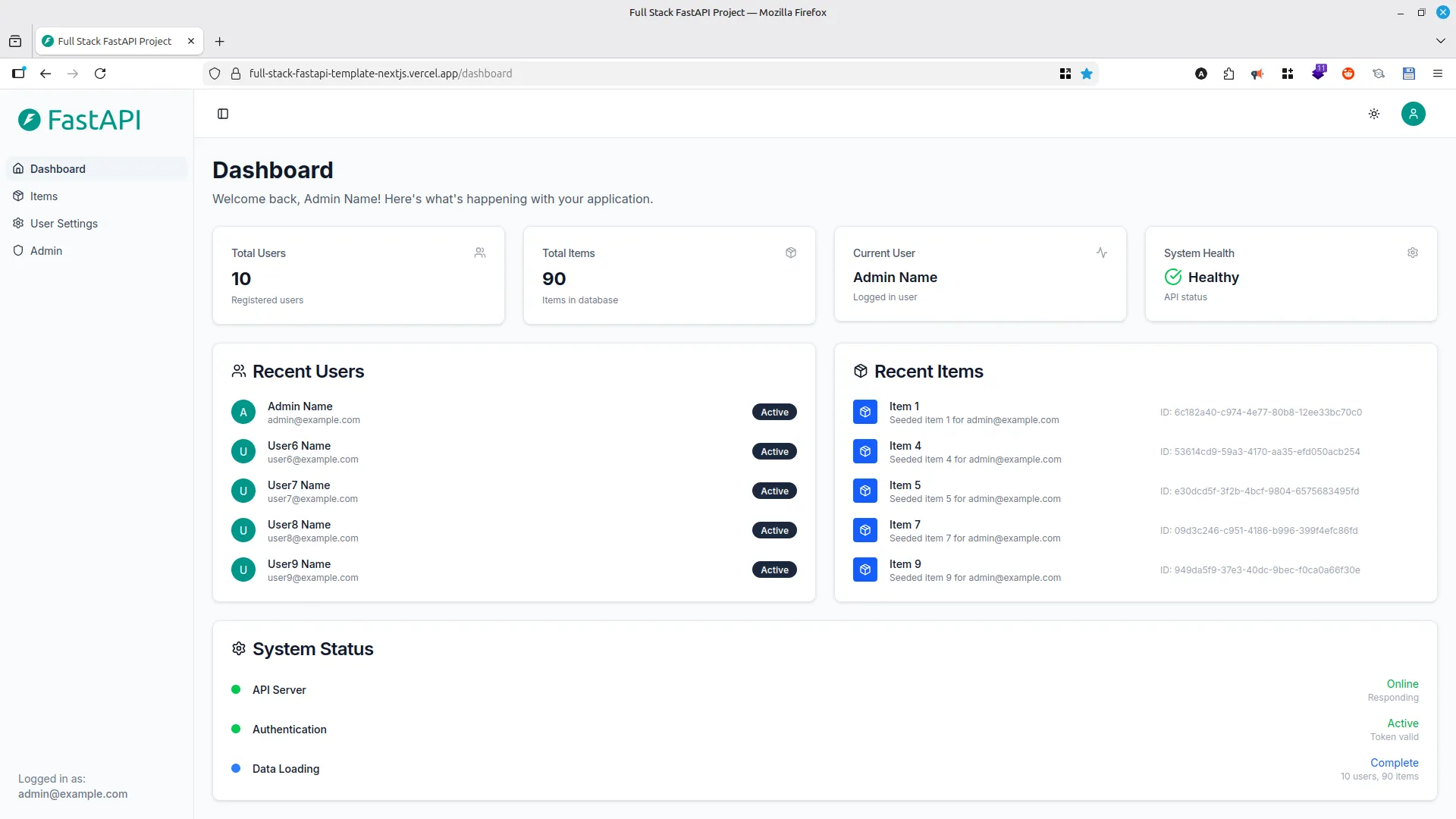
Next.js v16 fork of the official fastapi/full-stack-fastapi-template template. Server components, server actions, HttpOnly cookie auth, Github login, ShadcnUI with TailwindCSS v4, Docker and Vercel production.
Goals
Integrate a solid, up-to-date SSR FastAPI, Next.js template to reuse as a starting point for future projects.
Tech stack
- Next.js, HeyApi, ShadcnUI, TailwindCSS, react-hook-form, next-public-env
- FastAPI, SQLModel, PostgreSQL, Authlib
- Docker, Github Actions, Vercel
Credits
- The original repository: fastapi/full-stack-fastapi-template
- Next.js client side rendered PR: https://github.com/fastapi/full-stack-fastapi-template/pull/1733
- HttpOnly cookie PR: https://github.com/fastapi/full-stack-fastapi-template/pull/1606
Features
- Next.js v16, server components
- React Hook Form and server actions for forms
- HttpOnly cookie auth, enables SSR
- Proxied HTTP requests, frontend and backend can use any domains
- Hey Api with client-next
- Suspense, error boundaries
- Turborepo monorepo, TailwindCSS v4, ShadcnUI
- Runtime only env vars with
alizeait/next-public-env, reusable build - Simple local dev environment
- Register page, Github login
- Deploy with Docker and Vercel
Implementation details
I needed a solid FastAPI, Next.js starter as a base for future projects. I reviewed all the examples I could find and discovered that the official fastapi/full-stack-fastapi-template was the closest to what I wanted. However, it still wasn’t a complete match, it relied entirely on client-side rendering using TanStack Router and Chakra UI, and handled authorization via tokens stored in localStorage.
I decided to fully customize it to fit my needs and preferences, so I rewrote the frontend from scratch using Next.js v16 with Server Components and Server Actions, along with ShadcnUI, Tailwind CSS v4, and a Turborepo monorepo setup. To enable SSR, I modified the backend to use an HttpOnly authentication cookie.
Additionally, I proxied all FastAPI endpoints through the Next.js server (via API routes and Server Actions), which significantly simplified and hardened the cookie setting/unsetting logic. This approach also enables hosting the backend and frontend on separate domains without requiring an external reverse proxy (e.g., Traefik, Nginx) or URL rewrites (e.g., Vercel).
I also added Github OAuth login using Authlib, since I plan to use it in my next project.
The repository also includes Github Actions workflows to build, push, and deploy the backend and frontend as separate Docker images.
The Next.js app is designed to rely exclusively on runtime environment variables, enabling reusable builds and Docker images that can run in any environment and under any domain.
Finally, I included Vercel configuration files and a “Deploy button” to make the project eligible for submission to the official Vercel templates gallery.
Lessons learned
- I gained practical experience working with Python, which was the primary reason I chose a FastAPI backend in the first place.
- Properly integrating a non-TypeScript backend with Next.js requires an extra step using the HeyApi OpenAPI client. A clear separation between client and server code (and imports) is mandatory to avoid build-time errors and requires additional care and attention.
- For authorization, establish clear boundaries between auth logic (FastAPI) and cookie management (Next.js server) to avoid dealing with fragile and complex cross-site cookies.
- This clear separation significantly simplifies and improves the robustness of deployments where the backend and frontend are hosted on separate domains. The tradeoff is a small overhead compared to direct HTTP calls to FastAPI endpoints.
- Enforce runtime environment variables in Next.js apps to enable reusable builds and Docker images, unless there is a specific reason not to. alizeait/next-public-env is a great tool for this purpose.
I documented my findings in detail in the following blog posts:
- Runtime environment variables in Next.js - build reusable Docker images
- Next.js server actions with FastAPI backend and OpenAPI client
- Github login with FastAPI and Next.js
- Deploying a FastAPI and Next.js website to Vercel
Links
-
Vercel template: https://vercel.com/templates/template/full-stack-fastapi-template-with-next-js
-
Demo Docker: https://full-stack-fastapi-template-nextjs.arm1.nemanjamitic.com
-
Demo Vercel: https://full-stack-fastapi-template-nextjs.vercel.app
-
Repository: https://github.com/nemanjam/full-stack-fastapi-template-nextjs